WEB SDR 80m
The idea of design and implement the WebSDR in my hometown has appeared a few years ago.
My antenna conditions and available area didn’t allow me to install any long wired antenna for transmitting purposes. From the other hand, any shorten antennas haven’t worked fine. I haven’t been hearable nowhere with any WebSDRs available in Poland or abroad. The very similar was for receiving.
I’d gave up with my hometown and making QSOs, but I have been really motivated to find out what could be reason of my “deaf” hometown.
The second reason was the possibility to testing portable antennas in terms of directions. I love to spend my free time on countryside 100-200km away from home and play with different antennas installations. Very often I asked myself “Am I hearable at my hometown when transmitting?” when using 80m.
First of all before considering WebSDR installation is to check the internet connectivity condition. The basic requirement for the WebSdr to be launched is a good bandwidth available for upload. Based on the theoretical and experienced knowledge, system requires c.ab. 100kBit/s for one user. Very important is to have a public IP address and incoming TCP connections unlocked from the internet to your WebSDR server . I have to configure my home router to forward the port used by WebSDR connected to local network to be available from the internet.
The second thing is a server. This is most difficult part to be configured. It requires quite advanced knowledge about Linux systems and some other stuff (installation, scripting, administration, networking etc.). But don’t be afraid. If you are not very familiar with it, you’ll find the helping hand among other ham amateurs for sure. BTW, I have to choose the hardware for that. I have been looking for something small and quite powerfull to support that 300 MSps required for the system.
I decided to purchased HP Terminal 5735 with 1GB RAM and 1GB FLASH as HDD disk. There was no problem with swap the flash to 3,5” 30GB external HDD on ATA40pin connector, but the HDD had to be mounted outside the case of terminal. 1GB of Flash as a disk is not enough to install WebSDR.
I was thinking about the USB stick as a HDD, but I gave up with this idea, because I had the unused 3,5” disk.
I installed Debian with netinstall and the WebSdr engine provided by Peter previously. The whole process of configuration the WebSDR is clearly described within installation manual provided by author. Engine is available for x32 as well as x64 platform. I also equipped server with some scripting mechanism (changing the band with WWW etc.).
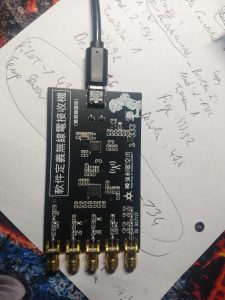
Next, let’s focus on the RTL-USB. I used the blue 820T2 one. Please note that the engine of WebSDR doesn’t provide the driver for particular RTL dongle. You have to install it on your own independently of WebSDR engine. Please find my another project related to the RTL 820T2 driver installation(Direct Sampling mode with 820T2). There you can find the detailed informations about this process. The clue is that rtl_tcp driver works as a service, which opens up the TCP port(by default 1234). The WebSDR engine has to connect to this service using address configured within the configuration file of WebSDR.
Now let’s start with the real HF part.
What the RTL 820T2 can and can’t receive? Manufacturer declares range of 24MHz up to 1766MHz
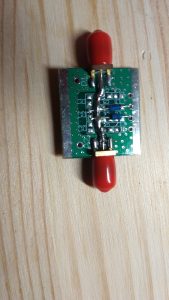
If we want to receive a very low frequencies (below 24MHz), we’ll have to use the upconverter device, which moves the considered range to the upper frequencies. In my case, I builded the 50MHz upconverter. It allows to receive the frequencies even below 1kHz. In this case, the 1kHz carrier at the input would be expected at 50,001 MHz at the output of upconverter.
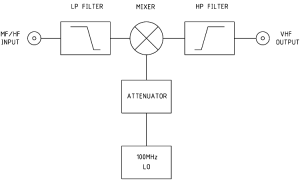
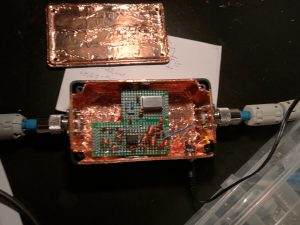
The very last one part is an antenna system. During WebSDR operating for last few years, antenna system has been changed few times. We had started with miniWhip through active Loop, Magloop and finally we changed the localisation from flat near Warsaw to countryside below Lodz in Poland.
ActiveLoop antenna is fine, but not for the expected band (80m). I reached quite nice results with SSB modulation on 11m(f.ex. 27.380 MHz) with it. Please note that the vertical ActiveLoop receives better that stations, which transmits with horizontal polarized antenna. In case of most 11m users (they use the vertical antennas), the ActiveLoop mounted horizontally would be better choice. MiniWhip antenna is deaf in terms of receiving local stations on 80m (it seems that it can’t receive the stations transmit at a high angle to the earth). In my case the best results are shown by the MagneticLoop antenna, tuned to c.ab. 3720 MHz. It shows best resistance for local interferences and allows to receive the stations, which I’ve been never available to receive. The results are much better than ActiveLoop and MiniWhip which are being equipped with the preamplifiers. Of course it can’t be compare to the wired antennas in terms of signals strength, but it won the competition in general in the very first WebSDR’s localization.
At the end of April 2018 we moved WebSDR from my home QTH to the center of Poland. The antenna has been swapped into Dipole.
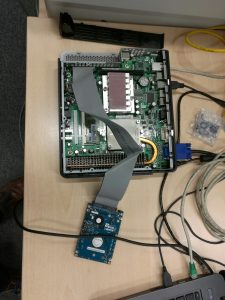
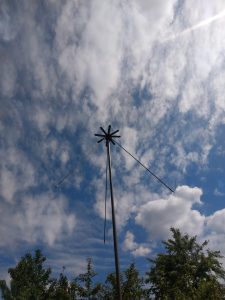

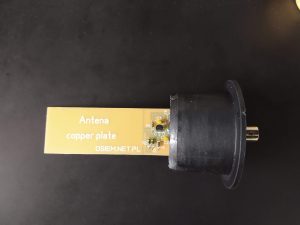
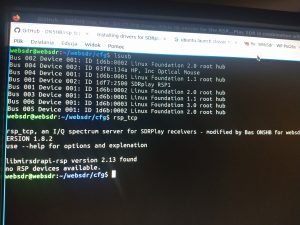
Please find some photos cover working progress:
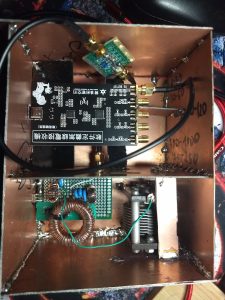
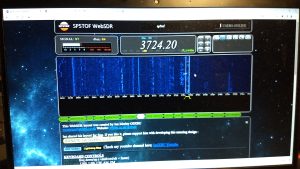
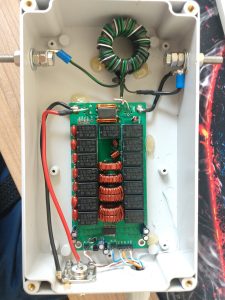
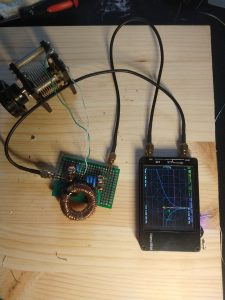
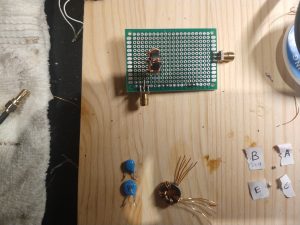
Currently, the Websdr has been switched off. This is due to very high background noise still rising in the websdr location. There’s no plan to reactivate it for now.